
 Check Port Open
 Disk Calculator
 Camera Calculator
 DMSS QR Generator and Decoder
 Super Password
 CCTV Quiz
 Facebook Profile Search

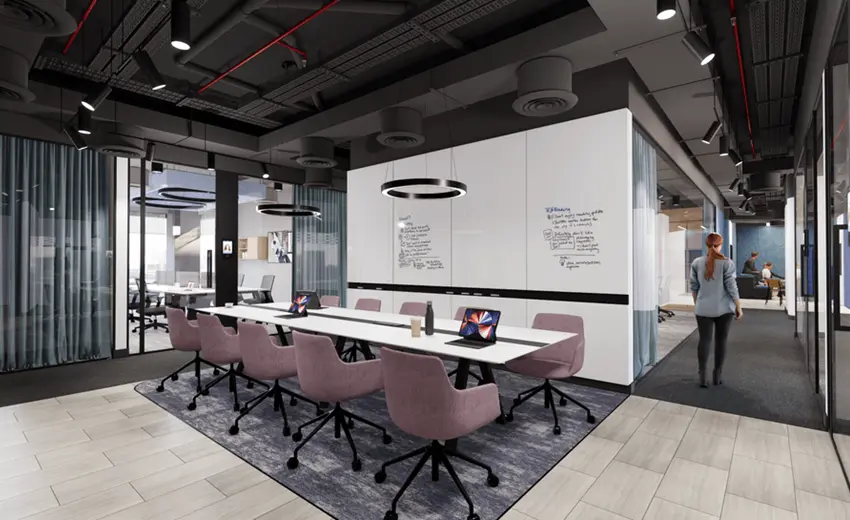
For a time, the future of the traditional office hung in the balance. The rise of remote work proved not only viable but, in many sectors, remarkably efficient. Across bustling Asian hubs like Singapore, Bali, and Bangkok, a new wave of professionals – digital nomads, hybrid teams, and distributed companies – embraced flexibility as the undisputed norm.
Yet, whispers of the office’s demise were greatly exaggerated.
In fact, the opposite has proven true. Global market studies, particularly the rapid expansion of flexible office spaces, reveal a surging demand for physical workplaces. Employees are indeed returning to shared environments, if not full-time, then at least on a hybrid basis. However, their expectations for these spaces have fundamentally transformed from just a few years ago.
Today’s office users demand environments that are:
* Safe and secure
* Hygienic and contactless
* Flexible and intuitively navigable
* Digitally enabled and personalized
In essence, they expect smart offices.
From “nice-to-have” to essential
While smart buildings have existed for decades, the global pandemic dramatically accelerated their evolution. What was once considered a forward-thinking innovation is now rapidly becoming a baseline expectation, especially within Asia, a region known for its swift and widespread technology adoption.
In cities brimming with co-working ecosystems and high workforce mobility, office operators face immense pressure to deliver:
* Seamless access to shared spaces
* Real-time occupancy visibility
* Minimal physical interaction with infrastructure
* Effortless experiences for both employees and visitors
The challenge is stark: how does one create an office that is both highly secure and utterly frictionless? This is where a particular technology is quietly becoming indispensable.
The rise of facial recognition in smart offices
Facial recognition technology (FRT) is rapidly solidifying its position in office environments – not as a futuristic gimmick, but as a practical, everyday operational tool.
Its profound value becomes particularly evident when viewed through the lens of post-pandemic expectations:
* **Reducing Touchpoints**
Access cards, keypads, and shared fingerprint scanners all introduce unnecessary physical contact. Facial recognition enables entirely contactless entry, seamlessly aligning with heightened hygiene and safety standards.
* **Managing Dynamic Occupancy**
In the fluid landscape of co-working spaces and hybrid offices, the flow of people changes constantly. FRT allows for instant, hands-free identification without manual checks or frustrating delays, ensuring smooth transitions throughout the day.
* **Enhancing Security Without Friction**
Unlike traditional credentials, biometric identifiers cannot be lost, shared, or duplicated, offering an unparalleled blend of robust security and effortless access. It’s a system that truly works for the user, not against them.
* **Improving User Experience**
No cards to carry, no passwords to remember – just seamless, intuitive movement through the workspace. This enhances convenience and productivity, allowing employees to focus on their work, not their access.
Offices as a key entry point for FRT deployment
Intriguingly, smart offices are also emerging as one of the fastest and most accessible environments for deploying facial recognition solutions.
Compared to more complex settings like airports, sprawling government institutions, or large manufacturing facilities, offices offer a more controlled environment. They involve lower infrastructure complexity, boast faster deployment timelines—often completed in just a few weeks—and provide straightforward scalability as operational needs evolve.
Consequently, many organizations, particularly across Asia, are leveraging office environments as practical proving grounds for biometric adoption. This allows them to implement, test, and expand the technology with minimal upfront effort and a quicker return on investment.
From concept to reality: a smart office in Dubai
A compelling example of this transformation can be seen in the implementation of facial recognition technology by RecFaces at the iSpace Smart Office in Dubai.
This facility, conceptualized as a flexible, technology-driven workspace, demanded a solution capable of supporting:
* Remote office management
* Automated workspace and meeting room booking
* High levels of security with minimal user friction
RecFaces deployed its Id-Gate facial recognition solution, meticulously integrating it with the office’s existing infrastructure.
The robust system empowers users to:
* Access the office effortlessly, without the need for cards or passwords
* Securely open lockers and utilize shared resources
* Move seamlessly and intuitively through various zones of the workspace
Identification is performed in less than a second, dramatically reducing waiting times and significantly improving overall flow within the facility.
Simultaneously, the system supports multi-factor authentication, intelligently combining biometrics with RFID cards or QR codes where specific scenarios require added flexibility.
An additional layer, Id-Welcome, introduces personalized interactions, gracefully greeting users and providing relevant information upon entry – a subtle yet meaningful stride towards a more human-centric office experience.
Deployment efficiency and scalability
The entire project was completed within a remarkably efficient one-month timeframe, underscoring the relative ease of deploying sophisticated biometric systems within office environments.
RecFaces provided comprehensive support, including:
* Expert infrastructure planning and consultation
* Seamless system integration support
* Thorough staff training
The solution is engineered as a ready-to-use platform, designed for straightforward scaling, whether expanding the user database or integrating new devices as the office evolves.
Results and business impact
Following this successful implementation, the iSpace smart office realized a multitude of benefits:
* Significantly improved operational efficiency, notably reducing the workload for security personnel
* Enhanced security posture, effectively eliminating risks associated with lost or shared credentials
* Faster and completely contactless access for both employees and visitors
* Greater visibility into office usage patterns, facilitating data-driven management decisions
Perhaps most critically, the system created an environment that perfectly aligns with modern expectations – an office that is safe, seamless, and inherently intelligent.
Outlook for the Asian market
The success story at iSpace Dubai is not an isolated incident; it reflects a broader and increasingly relevant trend across Asia.
As organizations throughout the region continue their substantial investments in smart offices and flexible workspaces, the demand for technologies that harmoniously combine security, automation, and user convenience is poised for exponential growth.
Facial recognition is exceptionally well-positioned to meet these burgeoning requirements, particularly within office environments, where implementation is quicker and the return on investment can be realized with impressive speed.
For many forward-thinking companies, embracing smart offices is not merely a response to post-pandemic expectations, but a practical and impactful starting point for broader digital transformation initiatives across their entire operations.
